GPT-6.1 Terra and the New AI Agents: What Changes for Your Brand's Visibility
OpenAI released GPT-6.1 Terra in late October 2026. On paper it is a model for "everyday work": filling in forms, reading technical drawings, editing video, handling repetitive desktop tasks. It is faster than OpenAI's larger models and costs half as much to run through the API.
It would be easy to file this under "developer news". That would be a mistake. Terra is part of a bigger shift that every marketing team should understand: AI assistants are moving from answering questions to doing things. And when an assistant acts for a buyer, the question is no longer only "does it mention my brand?" but also "can it actually use my website?"
Here is what that means in practice, and what to do about it.
What Is GPT-6.1 Terra?
GPT-6.1 Terra is OpenAI's mid-sized model, built for what OpenAI calls computer use: the model looks at a screen, understands it, and clicks, types and fills in fields to complete a task.
The key facts, as reported at launch:
- Faster and cheaper. OpenAI says Terra completes tasks more than three times faster than its larger models, at $1 per million input tokens and $5 per million output tokens, half the price of the previous Terra.
- Built for agents. OpenAI reports a large improvement on agent benchmarks, with far fewer errors on multi-step tasks.
- Where it runs. ChatGPT Work and Codex for paying plans, and the API for developers.
Terra does not arrive alone. The same month, OpenAI added parallel agents to GPT-6 Pro (several agents splitting one task), and Anthropic previewed Claude Duet, an agent that works in the background across a user's apps. The direction is clear: assistants that act, not just talk.
From Answers to Actions: Why This Matters for Brands
Until now, AI visibility mostly meant one thing: when someone asks ChatGPT "what is the best accounting software for a small agency?", is your brand in the answer?
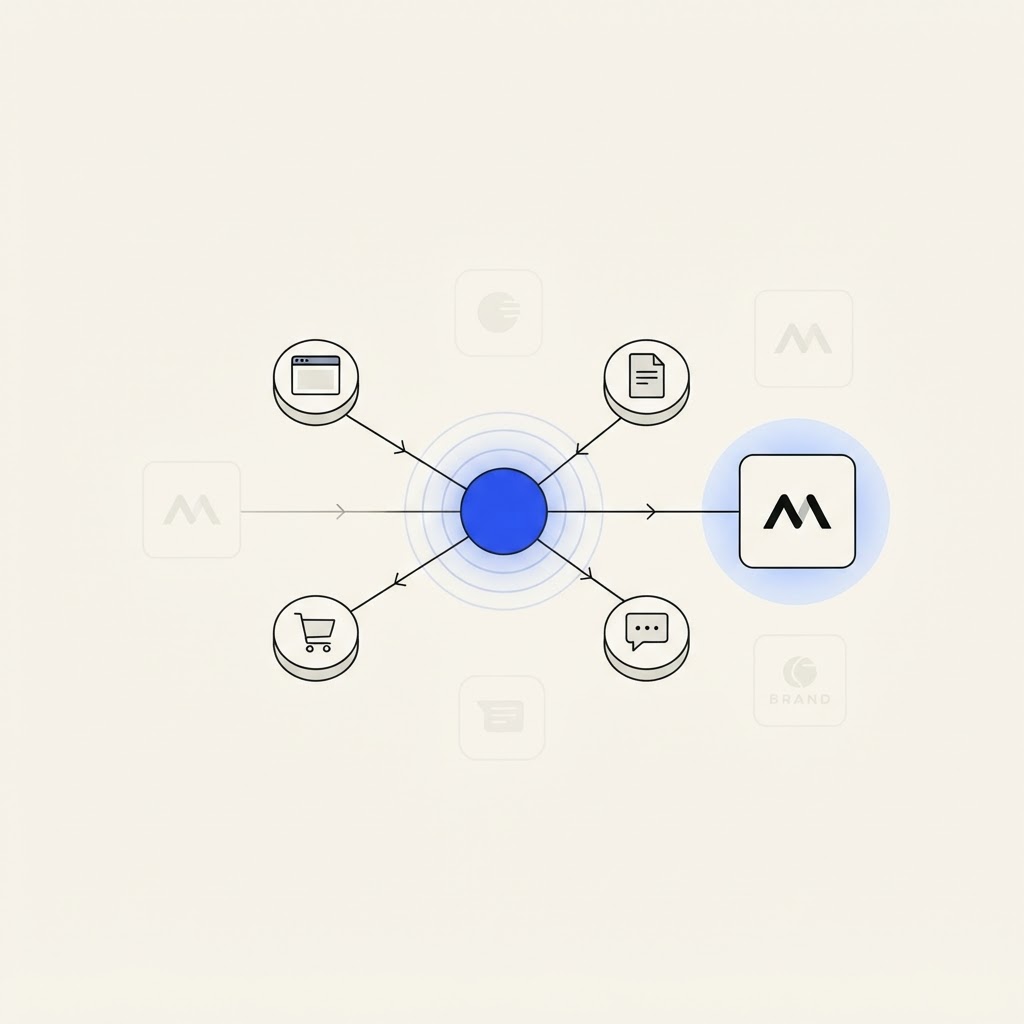
That still matters. But agents add a second step. A buyer can now ask an assistant to compare three suppliers, fill in a quote request, or book a demo. The agent visits the websites, reads them, and moves on with the ones it can understand and use.
That creates two ways to lose a customer you never see:
- The assistant does not name you, so the agent never visits your site.
- The agent visits but cannot use your site: the content only appears after JavaScript runs, the form is unreadable, prices or services are hidden in images, or AI crawlers are blocked. It moves on to a competitor whose site it can read.
Neither shows up in your analytics. There is no click, no bounce, no lost lead in your CRM. Just a deal that went somewhere else.
Cheaper Models Mean More AI in Every Buying Journey
Price matters more than it looks. When a model costs half as much, companies put it into more tools: procurement software, browser assistants, customer service, internal research. Each of those tools asks AI models to find, compare and recommend suppliers.
So the number of moments where an AI decides which brands a buyer sees keeps growing, often inside tools you will never know about.
New Models Change Which Brands Get Recommended
Every new model is trained and tuned differently, and it can search and weigh sources differently. A brand that ChatGPT recommended last month can disappear from the same answer after a model update, and come back the month after.
Our own data shows how unstable this is. Across the AI answers we sampled for the brands we track, a quarter of brands appeared in fewer than 1 in 10 ChatGPT answers to their own buyers' questions, and 16% were never named at all. And 88% of the sources assistants cited were third-party sites, not the brand's own website.
Two lessons follow:
- A one-off check is not enough. Visibility in AI answers needs to be measured over time, across several assistants, with real buyer questions asked several times. One answer is too random to mean anything.
- Your own website is only part of the story. What review sites, comparison articles, directories and forums say about you weighs more than your homepage.
How to Prepare Your Brand for AI Agents
None of this requires a new website. It requires making sure the one you have works for machines as well as people.
1. Let AI crawlers in. Check your robots.txt. Many sites block GPTBot, ClaudeBot or PerplexityBot without knowing it, often through a security plugin or a CDN setting.
2. Make your content readable without JavaScript. If your homepage is blank until scripts run, most AI crawlers see a blank page. Server-rendered or pre-rendered pages fix this.
3. Describe your business in structured data. Organization and FAQ schema tell an assistant, in a format it reads directly, who you are, what you sell and where. This is also what an agent relies on when it compares suppliers.
4. Keep the facts plain. Services, areas covered, prices or "from" prices, how to get a quote: in text, on the page, not inside images or PDFs.
5. Make key actions simple. A short contact or quote form with clear labels is easier for an agent to complete than a multi-step widget.
6. Publish an llms.txt file. It is a short Markdown summary of your site written for language models. It is not a ranking factor, but it is cheap and helps assistants find your most useful pages. Our guide to llms.txt explains how to write one.
7. Work on the sources assistants trust. Find out which sites the assistants cite for your category, and make sure you are present and accurate on them. That is usually where the gap with competitors comes from. Our GEO guide covers this in detail.
8. Track it every week. Ask the questions your buyers ask, in ChatGPT, Claude, Gemini, Perplexity and Google's AI Overviews and AI Mode, and watch the trend, not a single answer. A model update like Terra is exactly the kind of event that moves the numbers.
Check Where You Stand
You can start with the free AI visibility checker: enter your website and see in under a minute whether AI assistants can read it, with the fixes to make first. To see which brands ChatGPT, Claude, Gemini, Perplexity and Google AI actually recommend for your buyers' questions, and how that changes week after week, start a free trial of Operato AI.
FAQ
What is GPT-6.1 Terra? GPT-6.1 Terra is a mid-sized OpenAI model released in October 2026. It is designed for computer use and everyday work tasks such as filling in forms or reading documents, and is faster and cheaper than OpenAI's larger GPT-6 models.
Does GPT-6.1 Terra change how ChatGPT recommends brands? Any new model can change which brands an assistant recommends, because each model weighs sources differently. The bigger change with Terra is agentic: assistants can now visit websites and complete tasks for a buyer, so your site must be readable and usable by AI, not just visible in answers.
How do I know if AI agents can use my website? Check that AI crawlers are allowed in robots.txt, that your content appears without JavaScript, and that your business is described in structured data. The free AI visibility checker tests these points automatically.
How often should I check my brand's AI visibility? Every week. AI answers vary from one day to the next and change with each model update, so a single check gives a misleading picture. Weekly tracking across several assistants shows the real trend.