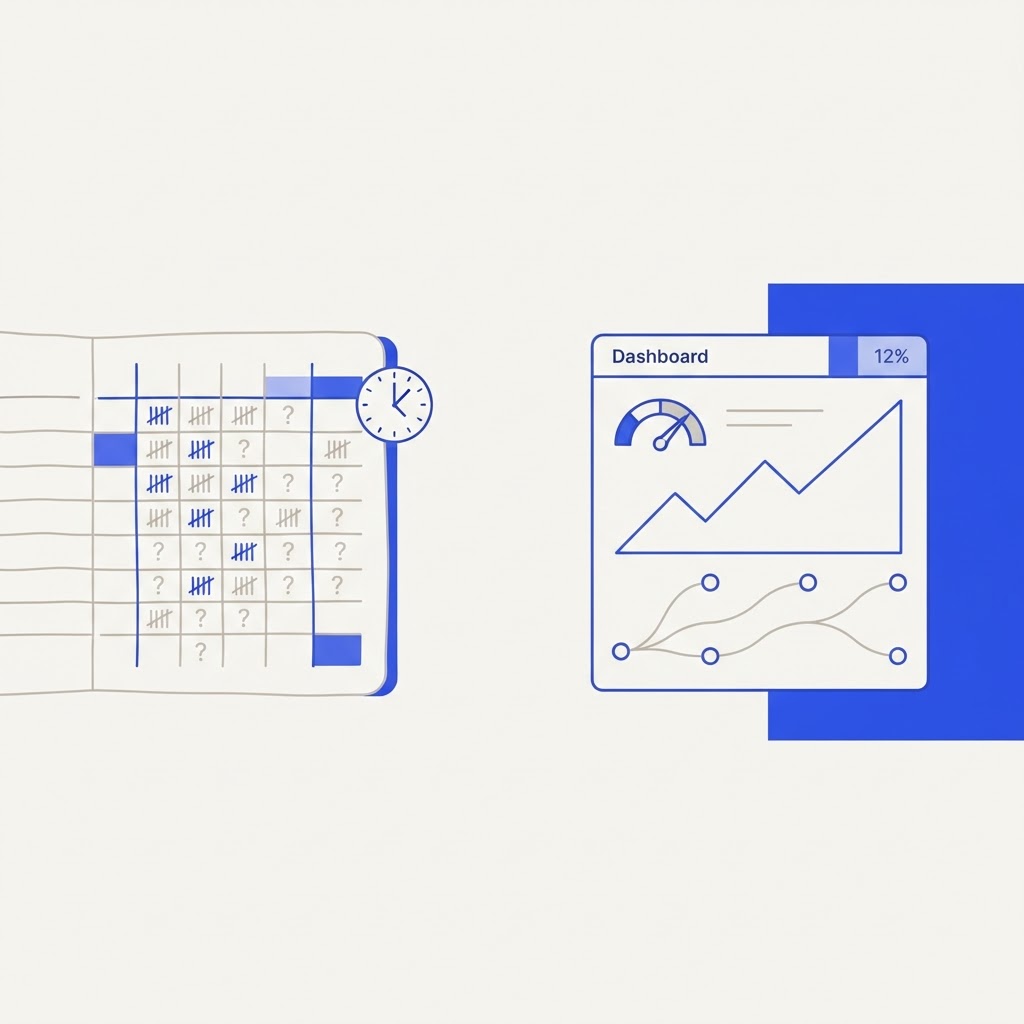
Can You Track Your AI Visibility by Hand? What It Really Costs
Every discussion about AI visibility tools on Reddit ends up with the same comment: "Why pay for this? Just ask ChatGPT yourself."
It's a fair point. If you have never checked what AI assistants say about your business, opening ChatGPT and asking "what's the best [your category] in [your city]?" is exactly the right first step. It's free, it takes two minutes, and it's often an eye-opener.
The problem starts when you want to do it properly: across several assistants, with the questions your buyers really ask, every week, and compared with your competitors. That's where doing it by hand stops being free.
The math of doing it by hand
Let's take a realistic setup for a small business or a marketing team:
- 50 buyer questions ("best accounting firm for startups in Lyon", "alternatives to [competitor]", "is [your brand] reliable?")
- 6 AI assistants: ChatGPT, Claude, Gemini, Perplexity, Google AI Overviews and Google AI Mode
- Once a week
That's 300 answers to read every week. For each one, you have to ask the question, read the whole answer, note whether you are named, in what position, which competitors appear, and which websites are cited as sources. Count about a minute and a half per answer.
That's around 7.5 hours a week, or 30 hours a month, just to collect the data, before you have analysed anything or fixed anything. For most marketers and business owners, those 30 hours cost far more than a monitoring tool.
And in practice, nobody keeps it up. After two or three weeks, the spreadsheet stops being updated, and you are back to guessing.
Manual checks are often wrong
Time is only half of the problem. The other half is that manual results are often misleading.
Your own account skews the answers. When you are logged in, ChatGPT knows your history, your preferences and often your company. What it tells you is not what a stranger looking for a supplier sees.
Location changes everything. AI answers, and Google's AI Overviews and AI Mode in particular, depend on where the question comes from. If you are in London and your customers are in Toronto, checking from your desk tells you very little about what your buyers see.
Answers change from one day to the next. Ask the same question twice and you can get two different lists of brands. A single check is a snapshot that can make things look much better, or much worse, than they are. Only a regular record shows the real trend.
The questions drift. By hand, the wording changes a little each week, and the comparison stops being valid. A tool asks exactly the same questions, the same way, every time.
What you simply can't see by hand
Some of the most useful information is almost impossible to gather manually.
- Who gets recommended instead of you, counted across hundreds of answers rather than remembered from three.
- The sources behind the answers. Assistants rely on a small set of websites in each category: review sites, comparison articles, directories, forums. Knowing which ones, and where you are missing, is usually where the quickest wins are. Nobody notes every cited link by hand.
- The history. How your visibility moved week after week, what changed after a new AI model was released, or after you published a new page.
- The breakdown. You can be well placed in ChatGPT and invisible in Google AI Mode, or strong in one country and absent in another. That only shows when everything is measured the same way.
From data to action
Collecting answers is not the goal. Knowing what to do next is.
Operato AI turns the answers into a prioritized action plan: what to fix first, with the steps. It writes content briefs for the pages that would get you cited, and checks your website the way AI crawlers see it (crawler access, content readable without JavaScript, structured data, llms.txt), with the fixes ready to copy.
By hand, that analysis is a second job on top of the first one.
AI keeps changing, and the tool keeps up
A year ago, tracking ChatGPT was enough. Today, buyers also use Claude, Gemini, Perplexity and Google's AI Overviews and AI Mode, and new models come out every month. Each new model can change which brands get recommended.
With a manual routine, every new assistant means more hours, and every model update means starting over. With Operato AI, new assistants are added to your tracking without you doing anything (Google AI Overviews and AI Mode were added in October 2026), and model updates show up directly in your weekly trend. Competitors are suggested automatically too, including local businesses that general AI knowledge doesn't know about.
It runs on its own
The scan runs every week without you lifting a finger, and a weekly email tells you what changed. For agencies, it means one clear report per client instead of a folder of screenshots. And it works in English and French.
So, manual or tool?
Check by hand once, today. It's the best way to understand the problem. If what you see worries you, or if AI assistants are starting to matter for how your customers find you, that's the moment a tool pays for itself.
In one sentence: checking ChatGPT by hand tells you what it said today, to you. Operato AI tells you what six assistants tell your buyers, every week, and what to do about it.
You can start with the free AI Readiness Score, which checks in under a minute whether AI assistants can read your website, or start a free trial to see who AI recommends instead of you. For the bigger picture, read our guide to generative engine optimization.
FAQ
Can I track my AI visibility manually? Yes, and it's a good first step. For regular tracking across several assistants and dozens of questions, it takes around 30 hours a month and the results are often skewed by your own account and location.
Why do I get different answers from ChatGPT than my customers? When you are logged in, ChatGPT uses your history and preferences, and AI answers also depend on location. What you see from your own account is not what a new buyer in another city or country sees.
How many AI assistants should I track? At least the ones your buyers use: today that usually means ChatGPT, Gemini, Claude, Perplexity and Google's AI Overviews and AI Mode.
How often should AI visibility be checked? Every week. AI answers vary from one day to the next and change with each model update, so only a regular record shows the real trend.