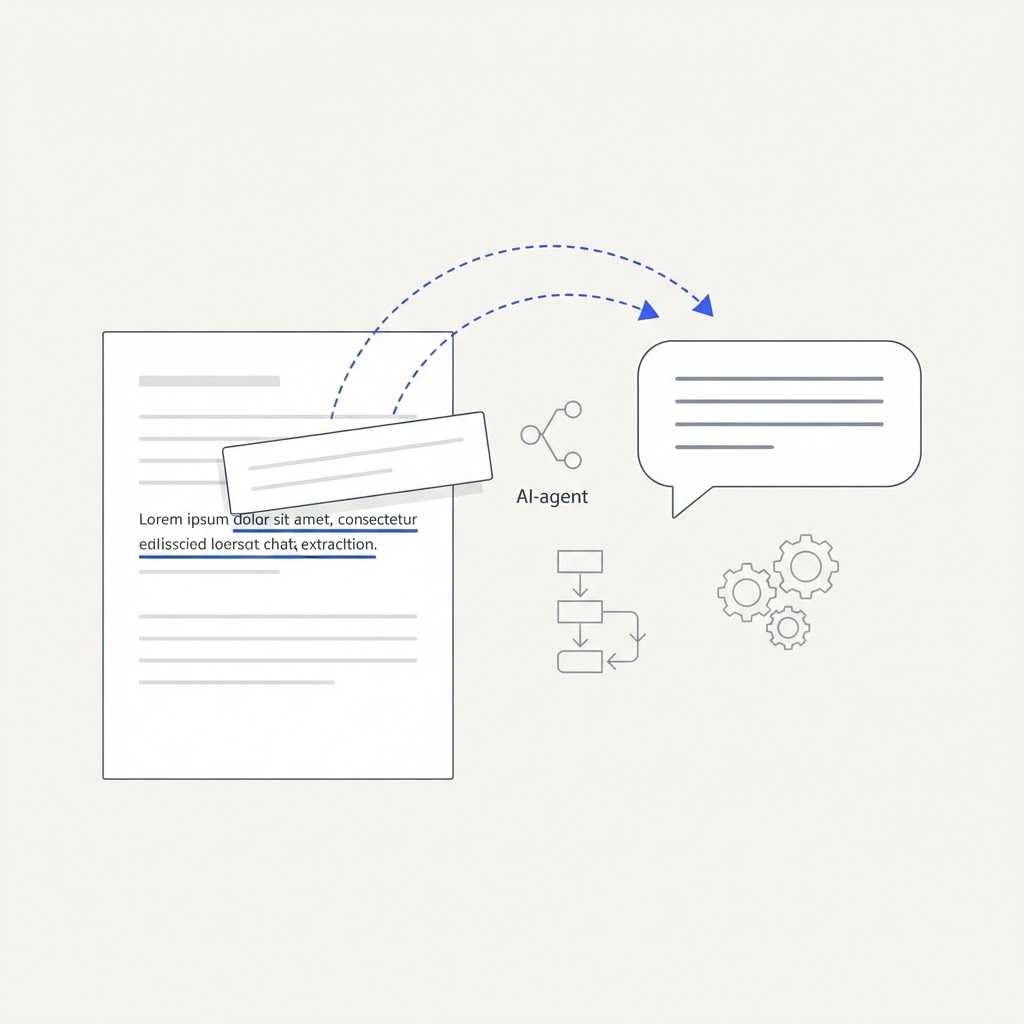
Most content that never gets cited by AI isn't wrong or low-quality, it's just structured for skimming, not for extraction. AI assistants pull answers from pages where the point is stated plainly, close to the top of a section, in language that can be lifted as-is. If your team is publishing regularly and still never showing up when someone asks ChatGPT, Gemini, or Perplexity about your category, the content itself is rarely the real blocker. How it's built usually is.
Why Doesn't AI Cite Your Content, Even When It's Good?
Because "good" for a human reader and "citable" for a model are different things. Humans tolerate a long intro, a build-up, a story before the point. Models extracting an answer for a chat response don't wait around, they pull whatever sentence most directly answers the question, wherever it sits on the page. If your best insight is buried in paragraph six after three paragraphs of context-setting, a model summarizing the topic is statistically more likely to lift a competitor's blunter, more direct sentence than to dig for yours. Quality and extractability are not the same axis, and most teams have only ever optimized for the first one.
Does Adding an llms.txt File Actually Get You Cited?
Less than most vendors claim, and you should go in with realistic expectations. llms.txt is a Markdown file at your site root that lists your canonical pages for AI crawlers and RAG pipelines to ingest. It has a real, narrow use case: agentic tools and retrieval pipelines that programmatically fetch your content benefit from a clean manifest. But several independent analyses in 2026 covering large numbers of domains have found no measurable correlation between having an llms.txt file and being cited by ChatGPT, Perplexity, or Google AI Overviews (estimate, per third-party research, not Operato AI's own measurement), and no major AI platform has publicly committed to prioritizing it. Set it up if you have the time, it's low-effort and doesn't hurt, but don't treat it as the fix. The actual levers that move citations are structural, not a manifest file.
What Structure Actually Makes Content Quotable by AI?
A direct, self-contained answer of two to three sentences immediately under a question-format heading, before any qualifiers or caveats. This is the single highest-leverage change most content teams can make, and it costs nothing but a rewrite pass. Compare "There are many factors that influence how a business might approach this, and it depends on several variables..." against "The three factors that matter most are X, Y, and Z." A model summarizing your page will lift the second version almost verbatim; it has nowhere useful to grab from the first. Apply this to every H2, not just the intro, headings phrased as the actual question someone would type or ask, followed immediately by the answer.
Does Schema Markup Help AI Models Cite You?
Yes, indirectly but meaningfully. Article, FAQPage, and Organization schema don't force a citation, but they make your content's structure and provenance unambiguous to any system parsing the page, human-facing crawler or otherwise. FAQPage schema in particular maps almost one-to-one onto the "question in, answer out" format AI assistants themselves produce, which is likely part of why FAQ-structured content shows up disproportionately often in AI-generated answers. Pair this with a genuinely clean, non-JavaScript-dependent render of the page (or a server-rendered mirror if your site is a single-page application), since a crawler that can't render your page at all can't cite anything on it, no matter how well it's structured.
Why Does Third-Party Corroboration Matter More Than Your Own Page?
Because models weight information they see repeated across independent sources far more heavily than a single confident claim from a company's own site, that's just self-promotion until something else corroborates it. If your best explanation of a topic exists only on your own blog, a model has one source and no way to confirm it's accurate or consensus. If the same idea, cited with attribution or not, shows up in a Reddit thread, a comparison roundup, a forum answer, and a review site, the model treats that as converging evidence and is far more likely to surface it, sometimes pointing back to your original source, sometimes just reflecting the consensus you helped shape. This is why the highest-leverage GEO work often isn't more blog posts, it's getting your explanation genuinely useful enough that other sites reference it or ask you to contribute to theirs.
How Do You Know If AI Is Reading Your Content at All?
Check your server logs (or your CDN/hosting dashboard) for requests from known AI crawler user agents, GPTBot, ClaudeBot, PerplexityBot, and Google-Extended, before worrying about whether you're being cited. If those crawlers aren't hitting your pages at all, citation is a moot question, the content is invisible to the model before it ever gets a chance to be extracted. Common causes: content rendered entirely client-side with nothing in the initial HTML response (a real risk for JavaScript-heavy sites and single-page apps), a robots.txt that unintentionally blocks AI crawlers, or pages that are simply too new or too deep in the site structure to have been discovered yet. This is a different failure mode than "the content isn't quotable," and it's worth ruling out first since the fix, usually a server-rendered version or a crawler-accessible mirror, is completely different from a content rewrite.
What Should You Fix First If Nothing Is Getting Cited?
In this order, since each step is a prerequisite for the next: first, confirm AI crawlers can actually reach and read your pages (the crawlability check above). Second, rewrite your highest-value pages so every heading has a direct 2-3 sentence answer right underneath it, no build-up. Third, add Article and FAQPage schema so the structure is explicit, not just visually apparent to a human reader. Fourth, and slowest but most durable, start showing up in the third-party places, forums, comparison content, review sites, where your category gets discussed, so your explanation gets corroborated instead of standing alone. Most teams try to skip straight to step four (pitching for mentions) while steps one and two are still broken, which wastes the effort, a mention pointing to an uncrawlable or unquotable page doesn't convert into a citation either.
Frequently Asked Questions
Why isn't AI citing our blog even though we publish regularly? Usually because the content is written for skimming, not extraction, the useful answer is buried after too much setup, rather than stated plainly right under the relevant heading. Frequency of publishing doesn't fix a structural problem.
Does llms.txt help get our content cited by ChatGPT or Perplexity? Not reliably. It's a legitimate manifest for agentic/RAG pipelines, but independent 2026 research found no measurable link between having one and being cited by the major AI assistants. The structural levers below matter far more.
What's the single fastest fix to make content more AI-citable? Put a direct 2-3 sentence answer immediately under every question-format heading, before any caveats or context. This is the change most content teams haven't made yet and it's nearly free to implement.
How do I check if AI crawlers can even see our content? Look for GPTBot, ClaudeBot, PerplexityBot, and Google-Extended in your server or CDN logs. If those crawlers aren't showing up, the issue is crawlability (often a JavaScript-rendering or robots.txt problem), not content quality.
Does getting mentioned elsewhere on the web actually help our own AI citations? Yes, often more than another blog post on your own site. Models weight the same idea appearing across independent sources, forums, comparisons, reviews, more heavily than a single claim from your own page, since it reads as corroborated rather than self-promotional.
Want a running view of what AI assistants actually say about your brand, instead of a manual check? See how Operato AI approaches AI visibility or book a walkthrough. If you haven't run a first check yet, start with how to audit what ChatGPT, Gemini, and Perplexity say about your company, or read the difference between GEO and classic SEO if you're still mapping the two disciplines. Explore AI visibility strategy work, or automation tools for keeping brand information consistent everywhere models look. More on the Operato AI blog.