Why Do B2B Buyers Ask AI to Shortlist Vendors Before They Ever Visit Your Site?
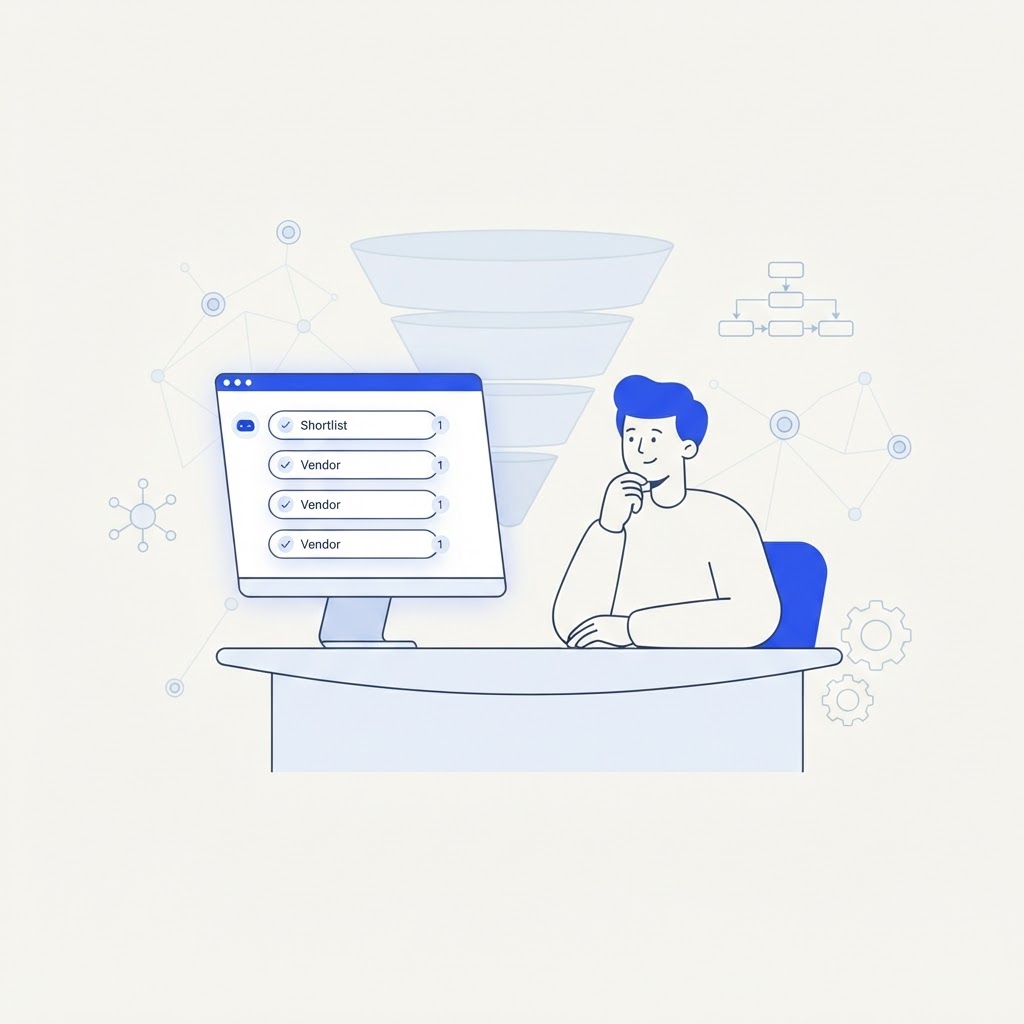
A sales rep closes a discovery call and hears something that used to be rare: "we already looked at three tools, ChatGPT suggested them." Yours wasn't one of the three. The prospect isn't being difficult, they're describing how buying actually starts now. By the time they fill out a form or book a demo, a chunk of the shortlist decision already happened somewhere you can't see and can't influence after the fact.
This isn't a future trend. It's already showing up in pipeline data as deals that feel "pre-decided" the moment they reach a rep, and as traffic that looks flat even though product quality and sales execution haven't changed. If you only measure what happens after someone lands on your site, you're measuring the funnel after the part that increasingly decides who's even in it.
What does "AI vendor shortlisting" actually look like?
It's less dramatic than it sounds. A buyer, usually someone on a small team without a dedicated analyst, opens ChatGPT or Perplexity and asks something like "what are the best [category] tools for a 50-person SaaS company" or "compare [competitor] alternatives." The assistant answers with three to five named options, often with a one-line reason for each. The buyer treats that list as a starting point, sometimes the only list they build before reaching out.
Nobody files this under "marketing research" the way a Google search with ten blue links gets tracked. It happens in a private chat window, leaves no referral data, and produces a decision that looks, from your side, like a prospect who simply "already knew what they wanted" when they showed up.
Why is this happening now, and why especially in B2B?
Three things are converging. First, AI assistants have gotten good enough at structured comparison questions that people trust a quick answer over ten tabs of research, especially for categories with lots of similar-sounding vendors. Second, B2B buying committees are often small and time-pressed, a marketing lead or ops manager doing vendor research on the side of their real job reaches for the fastest credible answer, not the most thorough one. Third, the category itself (software, tools, services with real differentiation that's hard to judge from a homepage) is exactly where a quick AI-generated comparison feels most useful, compared to, say, buying a commodity where any answer will do.
Put together: B2B software and services buying is one of the categories where this shift lands hardest, and earliest, because the research step was already the expensive, high-friction part of the journey that an AI assistant conveniently shortcuts.
How do you know if you're losing deals in the AI shortlist round?
Most teams don't find out through any dashboard, they find out anecdotally, and usually too late to do anything about the specific deal. A few more reliable signals to watch for:
- Reps increasingly report prospects arriving with a short, specific list of 2-3 competitors already in mind, named without being asked, before any sales material was shared.
- Deals where your product demo "confirms" a decision rather than shapes one. The buyer's questions sound like they're validating a choice, not exploring options.
- Flat or declining top-of-funnel traffic with no ranking drop to explain it. If your SEO position hasn't moved but inbound interest has, some of that research volume may be happening inside an AI chat window instead of a search results page.
- You ask ChatGPT or Perplexity the comparison question yourself and you're not on the list, while two or three specific competitors consistently are.
None of these alone is proof. Together, especially the last one repeated across a handful of realistic buyer prompts, they're a strong signal that the shortlist round is happening without you.
What determines which vendors actually get named?
AI assistants aren't picking favorites, they're pattern-matching against what's written about each option across the open web. What consistently correlates with being named in a comparison answer:
- Independent corroboration. Being mentioned in review sites (G2, Capterra), "best tools for X" roundups, Reddit threads where real users answer a similar question, and press, not just your own site. A model weighs what multiple sources say about you more heavily than what you say about yourself.
- Content that answers the comparison question directly. A page titled or headed "best [category] for [specific use case]" that names clear differentiators in plain language is far easier for a model to lift into an answer than a generic features page.
- A consistent entity across sources. One brand name, one canonical description of what you do, used the same way on your site, your listings, and in any press, so a model can confidently attach facts to you rather than hedge by leaving you out.
- Recency. For a fast-moving category, assistants with retrieval tend to favor sources that look current over ones that read as several years stale.
How can you get onto the AI shortlist?
Start by finding out where you actually stand, not guessing. Run the exact comparison prompts a buyer would type, across ChatGPT, Perplexity, and Gemini, and note who gets named and what's said about each option. That manual check is free and a reasonable starting point, though it only covers a handful of prompts and has to be repeated regularly to mean anything, since model answers shift as sources update. This is the specific, systematic version of that check that a tool like Operato AI is built to run on an ongoing basis, instead of relying on someone remembering to do it once a quarter.
Once you know where the gap is:
- Write the comparison page yourself, honestly, naming real alternatives and where you genuinely fit, not a thinly-veiled sales page disguised as a comparison.
- Get a third party to say it too. A real G2 or Capterra review, a forum answer, a mention in an independent roundup, these carry more weight with a model than anything on your own domain.
- Recheck the same prompts monthly. If your presence hasn't moved, the content or the corroboration wasn't strong enough yet; keep iterating on that one query before spreading effort across a dozen others.
Is this the same as SEO, or something different?
Related, not identical. SEO earns you a position in a list of links a human then clicks through and evaluates themselves. AI vendor shortlisting skips that step, the assistant does the evaluating and hands the buyer a pre-filtered answer. Good SEO fundamentals (clear, well-structured, authoritative content) still help, but they're not sufficient alone, because an AI assistant is drawing as much on what other sources say about you as on your own site. This is the generative engine optimization (GEO) layer sitting on top of classic SEO, and for B2B categories with real vendor comparison intent, it's increasingly where the actual decision gets made.
Operato AI tracks exactly this: where your brand stands the moment a buyer asks ChatGPT, Perplexity, or Gemini to shortlist your category, across engines, on an ongoing basis, with a clear action plan for what to fix first. It's one part of a bigger picture: explore how AI agents and broader automation tooling fit into an AI-visibility strategy, read more on the blog, check the team behind the product, or look at how AI strategy consulting can help you act on what you find. When you're ready to see where your brand actually stands, book a meeting.
FAQ
How do I know if I'm losing deals to this specific phenomenon versus just losing deals for normal reasons? Look for the pattern, not a single deal: reps mentioning prospects who arrive with a short, specific competitor list unprompted, combined with you not appearing when you run the comparison prompts yourself. One anecdote isn't proof; a repeated pattern across deals is.
Can a smaller or newer B2B company actually compete here against bigger, better-known competitors? Often yes, more than in traditional SEO, because the input a model weighs most is independent corroboration (reviews, forum mentions, honest comparisons), not domain authority or ad spend. A strong, specific G2 review and a well-written comparison page can outweigh a much bigger competitor's budget.
Does this mean I should stop investing in demos and sales enablement? No. It means the research step that used to happen through your sales materials now partly happens before a rep is ever involved. Sales enablement still matters for the deals that do reach a rep, it's the earlier, invisible round that needs its own attention now.
How often should I check where I stand in AI vendor comparisons? Monthly at minimum. Model answers shift as the web changes and as models get updated, a single check tells you today's snapshot, not whether you're gaining or losing ground.
Is this only relevant for software companies? It's sharpest for categories where buyers genuinely struggle to tell options apart from a homepage alone, which covers most B2B software and many services businesses, but any category with real vendor comparison intent ("best X for Y") is affected to some degree.