Does Your AI Visibility Tool Actually Work in French, or Is It Just a Translated Dashboard?
If you're a marketing team serving France, Québec, or any French-speaking market, you've probably already asked this question before buying an AI visibility tool: does it actually track what AI assistants say in French, or did someone just run the English UI through a translation plugin?
It's a fair question, and most of the AI-visibility category doesn't have a good answer. The tools built to track how brands show up in ChatGPT, Gemini, Perplexity, and Claude were almost all built English-first, for English-speaking markets, by English-speaking teams. French support, where it exists at all, is usually an interface language toggle bolted on after the fact. It is not the same thing as understanding how your brand is actually discussed, cited, or recommended when someone asks an AI assistant a question in French.
That gap matters more than it looks like at first glance, because AI assistants don't answer the same way in every language.
Why Does This Even Matter? Don't AI Models Just Translate Everything Internally?
No. The sources an AI assistant pulls from, and therefore what it says and who it recommends, can differ meaningfully between an English-language prompt and a French-language prompt, even for the exact same question.
When someone in Paris or Montréal asks ChatGPT or Gemini "quel outil de visibilité IA choisir pour ma marque," the model isn't just translating an English answer on the fly. It's drawing on the corpus of content that exists in French: French-language blog posts, French forum threads, French review sites, French press coverage. If your brand has strong English-language content and citations but no French footprint, you can be well cited in English and functionally invisible in French, for the exact same product, the exact same market positioning, just a different language of the question.
This is the same logic as classic SEO, where ranking well on google.com doesn't guarantee ranking well on google.fr, except most AI visibility tools haven't caught up to that reality yet.
What Does "Translated Dashboard" Actually Mean in Practice?
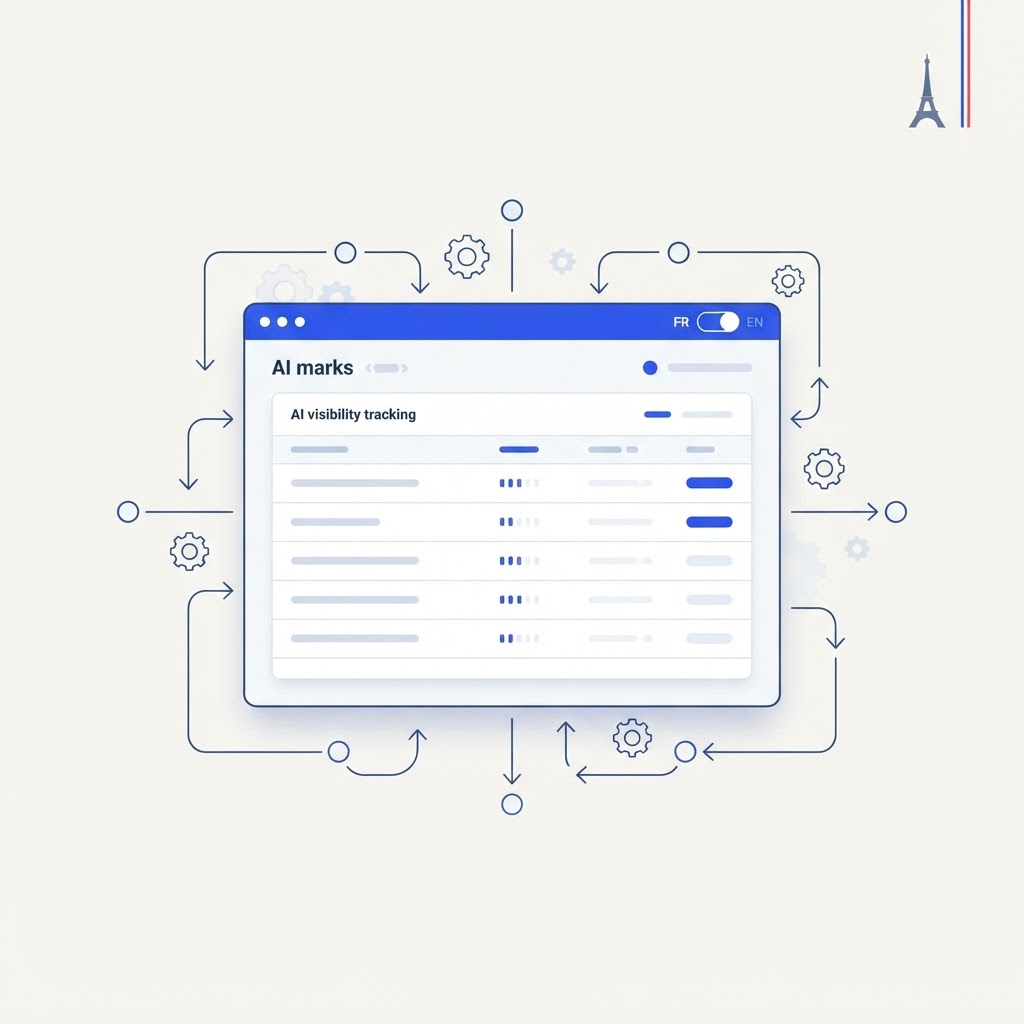
A translated dashboard means the tool's interface, buttons, and report labels are in French, but the underlying prompts, tracked sources, and analysis are still built around English-language AI answers.
In practice, this shows up a few ways:
- The tool runs its tracked prompts in English only, then presents results with a French-language UI skin. You get a report that looks native but measures the wrong thing.
- Keyword and prompt libraries are English lists translated literally, rather than built from how French speakers actually phrase the question. "Visibilité IA marque" and "brand AI visibility" are not interchangeable search behaviors, they're different queries with different volume and intent.
- Customer support, onboarding, and any human-reviewed insights are English-only, so a French-speaking marketing lead can't get help in their working language when something doesn't make sense in the data.
- There's no distinction in the reporting between "how does this brand appear in English-language AI answers" and "how does this brand appear in French-language AI answers" — they get blended into one score, which hides exactly the gap a francophone brand needs to see.
None of this is a dealbreaker if your market is English-only. But if a meaningful share of your buyers, press, or community conversation happens in French, a translated dashboard will quietly under-report a real visibility problem.
How Do You Tell the Difference Before You Buy?
Ask the vendor three direct questions: do they run tracked prompts natively in French, do they build French keyword/prompt libraries from real French search behavior rather than translated English lists, and can a francophone user get support in French.
A few more useful questions to ask during a demo or trial:
- "Show me a report where the French-language score and the English-language score for the same brand are different." If the tool can't produce that, it's probably not tracking the two separately.
- "Where do your French keyword suggestions come from?" If the answer is "we translate the English ones," that's the translated-dashboard pattern.
- "If I have a question about a French-language report, who do I talk to, and in what language?"
- Check whether the vendor's own marketing site has a genuine French version (not a machine-translated one) and a French blog with original content, not just translated English posts. If a company hasn't bothered to do this for its own visibility, it's unlikely to have built the muscle to do it properly for yours.
Why Does Bilingual Support Matter More Specifically for AI Visibility Than for Classic SEO Tools?
Because AI assistants generate a fresh, language-specific answer for every query, instead of just serving up a pre-ranked list of pages, so a language gap in the underlying content directly becomes a gap in what the AI recommends, in real time.
With classic search, a francophone searcher sometimes still lands on an English page if nothing better exists in French, Google will serve the best available result. With a generative AI answer, the model is more likely to either stay silent on your brand entirely or default to whichever competitor does have a clear French-language presence, including local or French-headquartered alternatives that an English-only tracking setup won't even flag as competitors.
This is also why francophone markets are a structurally different opportunity, not just a localization checkbox. Most of the well-funded names in the AI-visibility category, the Fortune-500-focused platforms with large enterprise contracts, build and support in English first and treat other languages as an afterthought if they address them at all. For a brand that genuinely serves France, Québec, or other French-speaking markets, that's a real gap, not a minor inconvenience.
What Should a Marketing Team Serving French Markets Actually Do About This?
Treat French-language AI visibility as its own tracked surface, not a filter on your English data, with its own prompt set, its own content plan, and its own reporting.
A short practical checklist:
- Build a French prompt list from real search behavior, not a translation of your English list. "Comment savoir ce que ChatGPT dit de ma marque" is a real way people ask this question in French, it isn't a literal translation of the English equivalent.
- Publish genuinely French content, written for French speakers, not machine-translated from English. AI models can often tell the difference, and so can the forums and review sites that feed them.
- Ask for a split report, English visibility score and French visibility score, tracked separately, so a strong English number doesn't mask a weak French one.
- Check your competitors' French footprint too. A competitor that's invisible in English might be well cited in French, especially if they're based in or focused on a francophone market, and you won't catch that from an English-only tool.
Operato AI tracks AI visibility across ChatGPT, Gemini, Perplexity, Claude, and the other major assistants, natively in both English and French, not as a translated add-on. French keyword and prompt libraries are built from real French search behavior, reporting splits English and French visibility so neither hides the other, and the product and support are genuinely bilingual, because the team building it is too. It's one part of a bigger picture: explore how AI agents and broader automation tooling fit into an AI-visibility strategy, read more on the blog, check the team behind the product, or look at how AI strategy consulting can help you act on what you find. When you're ready to see where your brand actually stands, in either language, book a meeting.
FAQ
Does ChatGPT answer differently in French than in English for the same question? Yes. The model draws on different source content depending on the language of the prompt, so the brands, sources, and recommendations it surfaces can differ between an English-language and a French-language version of the same question.
Can I just translate my English content to fix this? Literal translation helps a little but isn't the same as genuinely French-language content built around how French speakers actually search and phrase questions. Machine-translated content is also often detectable as such, which can work against the "quotable, trustworthy source" signal AI models look for.
Is this only relevant for brands based in France? No. It matters for any brand with meaningful buyers, press, or community conversation in French, including Québec, Belgium, Switzerland, and other French-speaking markets, regardless of where the company itself is headquartered.
How do I know if my current AI visibility tool is actually tracking French natively? Ask it to produce a French-specific visibility report, built from French-native prompts, separate from your English score. If it can't separate the two, or its French keyword suggestions are obviously translated from English, it's working from a translated-dashboard setup.
Does a French-capable AI visibility tool cost more? Not necessarily. It depends on the vendor's pricing model rather than the language capability itself. The bigger cost risk is the opposite: paying for a tool that silently under-reports half your actual visibility picture because it only measures the English side.