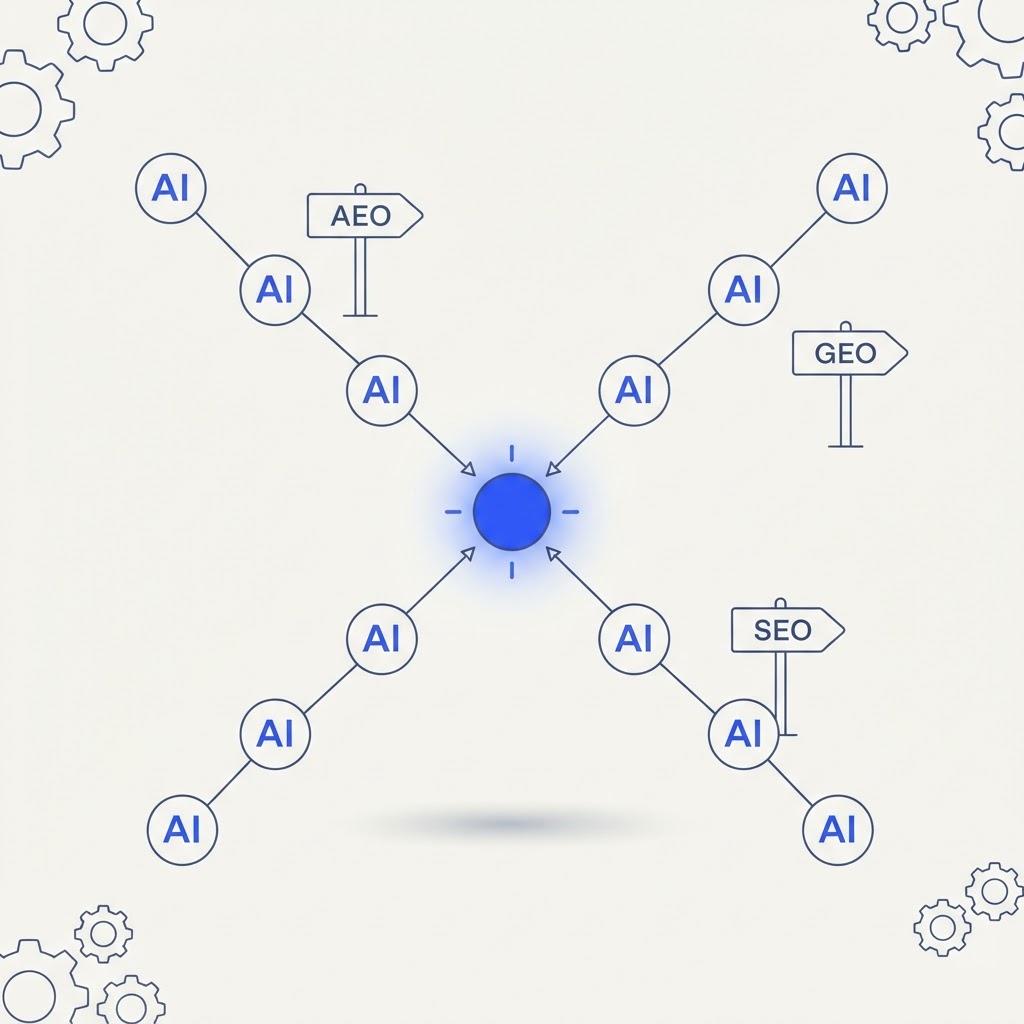
What Is AEO (Answer Engine Optimization), and How Is It Different From GEO and SEO?
Answer Engine Optimization, AEO, is the practice of structuring content and brand information so that answer engines, AI systems that respond to a question with a direct answer instead of a list of links, can find it, trust it, and use it in their response. That covers AI assistants like ChatGPT, Gemini, Perplexity, and Claude, as well as answer-style search features like Google's AI Overviews and featured snippets. If you've started seeing "AEO" show up in analyst reports or vendor pitches right after you'd just gotten comfortable with "GEO," you're not imagining the overlap. This article explains where the term comes from, how it relates to GEO and SEO, and whether you actually need to treat it as a separate thing.
Where Did the Term "AEO" Come From?
AEO has actually been around longer than people assume, originally used for optimizing content to appear in voice-assistant answers (Siri, Alexa) and Google's featured snippets, both "answer engine" formats that predate ChatGPT. It picked up new momentum once AI chat assistants went mainstream, because an AI assistant's response is, structurally, exactly the kind of direct answer AEO was always about: one synthesized answer instead of a ranked list. Analyst firms have formalized this, Forrester, for example, publishes an "Answer Engine Optimization Technologies Landscape" report covering vendors in this space, and some AI-visibility vendors market themselves explicitly as "AEO platforms." The term didn't get replaced by GEO, it got a bigger, more urgent audience.
Is AEO the Same Thing as GEO?
Functionally, they overlap heavily, and in most vendor and analyst usage today, they describe the same underlying work: making your brand and content more likely to be surfaced, cited, or recommended by an AI system responding to a question, rather than ranked in a list of links. The distinction, where people draw one, usually comes down to framing rather than substance:
- AEO tends to emphasize the answer format itself, snippets, voice responses, direct AI-generated answers, and is the older, broader term that predates the current AI-assistant wave.
- GEO (generative engine optimization) is the newer term, coined specifically around generative AI systems like ChatGPT, and tends to get used when the conversation is explicitly about large language models rather than the full range of answer-style formats.
In practice, most of what you'd do to improve one improves the other: clear, quotable answers; clean structured data; consistent entity information; third-party corroboration. If a vendor, analyst report, or competitor uses "AEO" and you've been thinking in terms of "GEO," you haven't missed a different discipline. You're looking at the same discipline through a different label.
How Does AEO Relate to Classic SEO?
The relationship is additive, not a replacement. Classic SEO optimizes a page to rank well in a list of search results, ten blue links, ranked by relevance and authority. AEO optimizes for a different outcome: being the source an answer engine actually pulls from, or names, when it generates a single direct response. A page can rank #1 on Google for a term and still never get surfaced when the same question is asked conversationally to an AI assistant, because the systems select and present information differently.
The practices overlap more than they conflict. Clear, authoritative, well-structured content tends to help both. But AEO adds specific requirements classic SEO doesn't check for on its own, an answer formatted so it can be lifted cleanly, consistency across the web beyond your own site, and machine-readable context (schema markup, clear entity information) that an answer engine can parse with confidence.
Why Are Vendors Suddenly Calling Themselves "AEO Platforms"?
Partly because it's the term some analyst firms chose, and getting included in a named analyst category (a Forrester landscape, a Gartner mention) is valuable enough that vendors adopt whatever label that category uses. Partly because "AEO" sounds more established and less like a trend than "GEO" does, useful positioning if you're trying to signal maturity to an enterprise buyer doing due diligence. Neither reason means AEO is a fundamentally different product category from AI-visibility or GEO tools, it's largely the same market, with vendors choosing the label that fits their positioning and the analyst coverage they're chasing.
Do I Need a Separate AEO Strategy, or Does My GEO Work Already Cover It?
If you've already started working on GEO, structuring content for quotability, cleaning up structured data, tracking presence across AI assistants, you're doing the large majority of what AEO asks for too. The practical checklist is the same regardless of which acronym you use:
- Direct, quotable answers under question-format headings, not buried in a longer narrative paragraph.
- Schema markup (Article, FAQPage, Organization) so machine readers can parse structure and intent without guessing.
- Consistent entity information across your own site and the third-party sources that mention you, so an answer engine isn't resolving conflicting descriptions of who you are.
- Third-party corroboration, reviews, comparison content, forum threads, directories, since answer engines weight what's said about you elsewhere, not just what you say about yourself.
- Ongoing tracking, since what an answer engine surfaces for a given question shifts as models update and as new content gets published and indexed.
The acronym on the vendor's homepage or the analyst report's cover page doesn't change what the actual work looks like.
How Does Operato AI Fit Into This, Whatever You Call It?
Operato AI tracks how your brand actually shows up across ChatGPT, Gemini, Perplexity, Claude, and the other assistants your buyers use, whether you call that AEO, GEO, or just "AI visibility," with presence, accuracy, and share of voice against named competitors covered in one place, and a prioritized list of what to fix rather than a score to interpret alone. It's built for growing brands that want this added to a stack they already run (SEO tooling, content, analytics), not a six-figure enterprise AEO platform contract. You can see how it fits your team by booking a walkthrough, read more on the about page, or see how it relates to AI strategy consulting more broadly.
FAQ
What does AEO stand for? Answer Engine Optimization: the practice of structuring content and brand information so that answer engines, AI assistants, voice assistants, and AI-generated search features, can find, trust, and use it in a direct response rather than a ranked list of links.
Is AEO different from GEO? Mostly a difference in framing, not substance. AEO is the older, broader term covering answer-format content (voice assistants, featured snippets, AI-generated answers). GEO is the newer term specifically tied to generative AI systems like ChatGPT. In current vendor and analyst usage, they describe largely the same work.
Does AEO replace SEO? No. SEO optimizes for ranking in a list of search results. AEO optimizes for being the source an answer engine cites or pulls from in a single generated answer. Most growing brands need both, since classic search and AI-assistant research both drive real traffic and pipeline.
Why do some AI visibility vendors call themselves "AEO platforms" and others say "GEO"? Largely positioning and which analyst category they're chasing (Forrester and others have published AEO-specific vendor landscapes). It typically doesn't signal a meaningfully different product or approach.
If I'm already doing GEO work, do I need to do anything differently for AEO? No. The practical checklist, quotable answers, clean schema, consistent entity information, third-party corroboration, ongoing tracking, is the same regardless of which term you or your vendor uses.